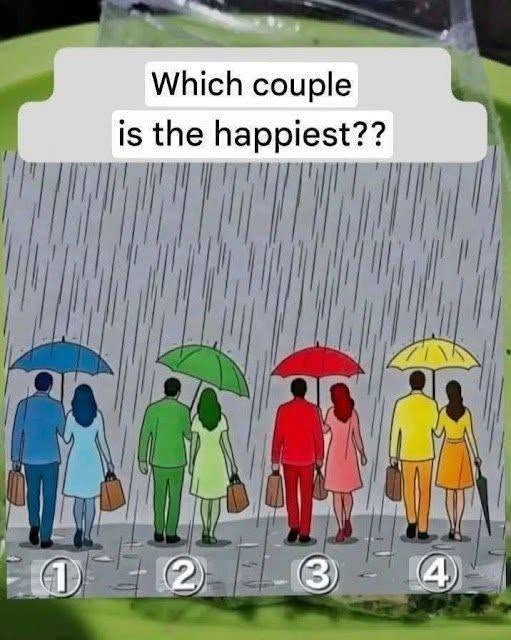
We naturally look for patterns.
We compare positions.
We examine body language.
We notice whether people are standing close together or slightly apart.
We may even attach emotional meaning to colors without realizing that we are doing it.
The puzzle therefore becomes less about the drawing itself and more about our interpretation of it.
Why Do We Immediately Look for Clues?
Human beings are constantly trying to understand other people.
Even in ordinary situations, we observe facial expressions, posture, gestures, tone of voice, and physical distance.
We use those signals to make quick judgments about how someone might be feeling.
A cartoon removes many of those clues.
There are no detailed facial expressions to examine.
That forces us to rely on whatever information remains.
We might focus on the couple’s posture.
We might compare their positioning.
We might look at their hands.
We might pay attention to whether one person appears to be leaning toward the other.
And when those clues are ambiguous, our minds may fill in the gaps.
This is one reason these puzzles can produce different answers from different people.
Two people can look at exactly the same picture and notice completely different things.
One person might see closeness.
Another might see independence.
Someone else might focus almost entirely on color.
None of those interpretations necessarily tells us what the illustrated characters are actually feeling.
But they can tell us something about what the viewer considers important.
The First Couple: The Blue Umbrella
The first couple stands beneath a blue umbrella.
Blue is a fascinating color in this context because people often associate it with calmness, peace, stability, and trust.
Those associations can influence how we interpret the couple before we have even examined their body language.
The man wears blue, while the woman wears a lighter shade.
They appear coordinated.
Both are carrying bags, suggesting that they may be traveling together or sharing the same activity.
A viewer who associates blue with emotional security may instinctively choose this couple.
They may think the pair looks peaceful and comfortable together.
But is that evidence of happiness?
Not really.
Color symbolism is subjective.
Blue can represent calmness to one person and sadness to another.
Someone who has positive memories connected to blue may respond differently from someone who doesn’t.
The same principle applies to every color in the image.
Our emotional response to a visual cue is influenced by personal experience, culture, and context.