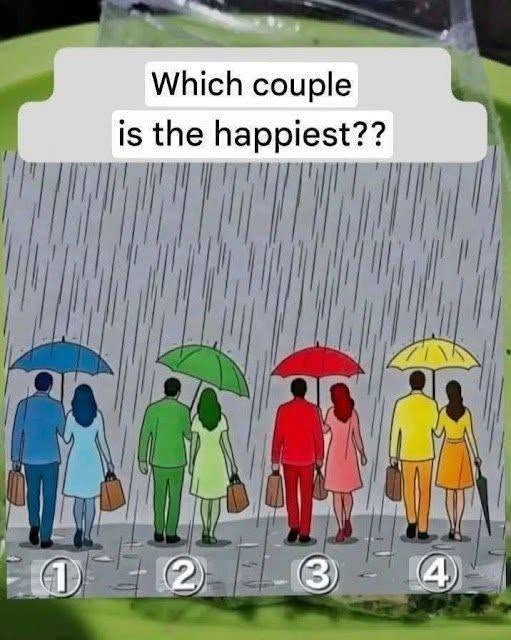
Compared with the cooler tones of blue and green, the couple may appear more cheerful simply because of the colors surrounding them.
But once again, there is an important distinction between looking cheerful and being happy.
A bright color palette can influence perception, but it cannot reveal what is happening emotionally.
That may be one of the central ideas hidden within this puzzle.
We often judge happiness from appearances.
We see a smiling couple in photographs and assume they have a perfect relationship.
We see two people who rarely post pictures together and assume something is wrong.
We see someone dressed confidently and assume they feel confident.
But appearances can be misleading.
The happiest moments in a relationship are often invisible to outsiders.
Is There Actually a Correct Answer?
Probably not—not in any scientific sense.
Unless the original creator has explicitly assigned a particular interpretation to one of the couples, there is no reliable way to establish that one pair is objectively happier than the others.
The image contains no measurable psychological information.
The characters aren’t real people.
We don’t know their histories.
We don’t know what happened before the scene.
We don’t know what they are discussing.
We don’t know whether they are celebrating something or simply walking home.
We don’t even know whether the rain is making them happy or miserable.
That uncertainty is important.
It reminds us that visual puzzles like this are usually entertainment rather than genuine psychological assessments.
They can be fun.
They can encourage observation.
They can spark conversations.
But they shouldn’t be treated as scientific tests that reveal someone’s personality or relationship style.
Why People Give Different Answers
Imagine showing this picture to ten different people.
You might receive several different answers.
One person chooses the blue couple.
Another chooses green.
Someone else immediately picks red.
Another insists that yellow is obviously the happiest.
Why?
Because people don’t look at images neutrally.
We bring our own experiences with us.
Someone who associates blue with peaceful relationships may choose the first couple.
Someone who values independence might interpret the second couple positively.
Someone who equates romance with passion may choose the red pair.
Someone who values optimism and warmth might pick the yellow couple.
The image becomes a mirror for those assumptions.
Not a perfect mirror, of course.
But an interesting one.
What Does “Happy” Actually Mean?