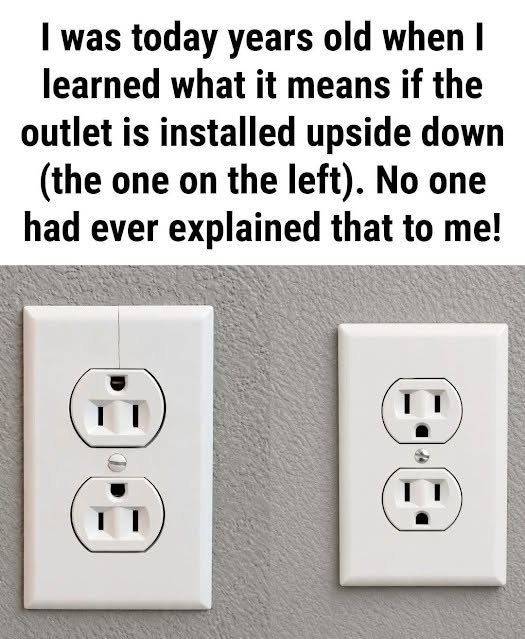
Why Some Electrical Outlets Are Installed Upside Down: The Surprisingly Practical Reason Behind This Common Mystery
Have you ever walked into a home, office, hospital, or commercial building and noticed that one electrical outlet is installed upside down while all the others appear “normal”?
For many people, it’s a surprising sight. Some assume the electrician made a mistake. Others think it’s a manufacturing defect or simply poor workmanship.
In reality, an upside-down outlet is often installed intentionally, and in many cases, it serves a practical purpose.
While there is no universal electrical rule requiring outlets to be installed in one specific orientation in most residential settings, electricians, builders, and facility managers sometimes choose different orientations for safety, convenience, or identification.
Let’s explore why this happens and what it might mean.
Is There a “Right Side Up” for an Outlet?
Most people think of an outlet as having the two vertical slots on top and the round grounding hole at the bottom.
That’s the orientation found in many homes.
However, from an electrical standpoint, a standard outlet generally functions the same regardless of whether it’s mounted with the ground pin up, down, or even sideways.
The National Electrical Code (NEC) in the United States generally does not require a specific orientation for standard receptacles in most residential installations. Instead, orientation is often left to local practice, builder preference, or the intended use of the outlet.
Understanding the Parts of an Outlet
A typical North American electrical outlet contains three openings:
The smaller vertical slot is the hot connection.
The larger vertical slot is the neutral connection.
The round opening is the grounding connection.
These three components work together to safely deliver electricity while providing a path for fault current if something goes wrong.
The position of these openings doesn’t change how electricity flows.
Why Do Some Electricians Install the Ground Hole on Top?
One of the most commonly cited reasons involves safety.
Imagine a plug that is only partially inserted into the outlet.
If a metal object—such as a picture frame, tool, or loose screw—falls between the plug and the wall, it could potentially contact the exposed metal prongs.
If the grounding pin is on top, the falling metal object is more likely to touch the ground pin first instead of the energized hot conductor.