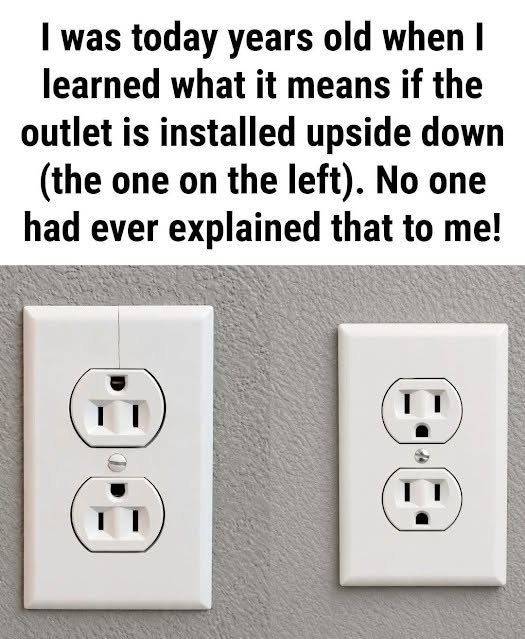
Because the ground connection is designed as a safety feature, this orientation may reduce the chance of creating a dangerous short circuit.
Although this situation is relatively uncommon, some electricians prefer the added layer of protection.
Hospitals Often Use This Orientation
If you’ve ever visited a hospital, you’ve probably seen many outlets installed with the grounding hole facing upward.
This isn’t because hospitals have different electricity.
Instead, many healthcare facilities follow engineering standards or institutional practices that favor this orientation for additional safety around sensitive medical equipment.
Hospitals also use specialized “hospital-grade” receptacles designed to hold plugs more securely and withstand frequent use.
Identifying Switched Outlets
Sometimes an upside-down outlet serves as a visual indicator.
In certain homes, one outlet may be connected to a wall switch while others remain continuously powered.
Instead of adding labels, electricians may install the switched outlet upside down so homeowners can quickly identify which receptacle operates with the switch.
This practice isn’t universal, but it has been used in many homes over the years.
Commercial Buildings May Have Their Own Standards
Office buildings, schools, warehouses, and retail spaces sometimes adopt company-wide electrical standards.
Some contractors choose to install every outlet with the ground pin facing upward simply for consistency.
Others continue using the traditional ground-down orientation.
Neither choice necessarily indicates better workmanship.
It Can Be a Builder’s Preference
Many aspects of construction involve professional judgment.
Just as painters may have different techniques or plumbers may route pipes
differently, electricians often develop installation preferences over years of experience.
Some learned from mentors who always installed outlets one way.
Others follow customer requests.
Neither approach is automatically incorrect if the installation meets applicable electrical codes.
Common Myths About Upside-Down Outlets
Because upside-down outlets attract attention, several myths have spread online.
Myth 1: It Means High Voltage
False.
The orientation has nothing to do with voltage.
Standard household outlets continue supplying their normal rated voltage regardless of which direction they face.
Myth 2: It Indicates Emergency Power
Sometimes—but not always.
Certain facilities may use outlet orientation as one method of identifying emergency circuits.
However, many emergency outlets are instead identified using color coding or labels.
An upside-down outlet alone doesn’t guarantee it’s connected to backup power.