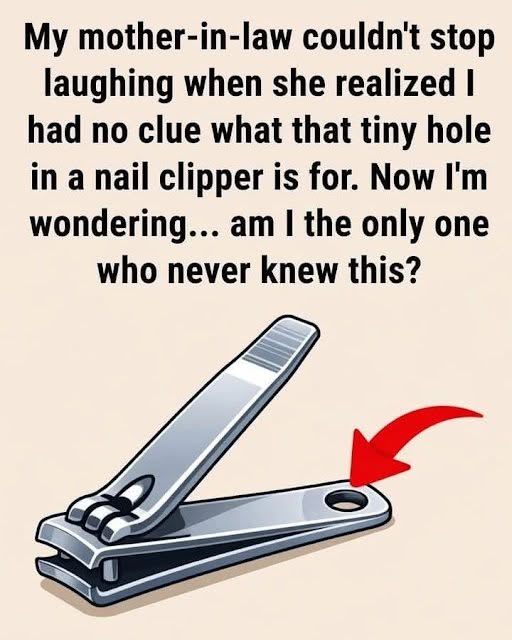
That may sound like a small feature, but anyone who has searched through a crowded bathroom drawer for a tiny nail clipper understands the value of convenient storage.
Some manufacturers also use holes or openings as part of the design of compact grooming kits.
In those situations, the opening can help keep several tools together.
But Is That the Only Purpose?
Not necessarily.
This is where online discussions about nail clippers can become confusing.
Different manufacturers use different designs.
The small opening may have a specific function on one model while serving a different purpose—or no significant practical purpose—on another.
Some nail clippers include holes that are primarily intended for manufacturing or assembly.
Others incorporate openings into handles or attachment points.
There are also nail clippers that have additional features built into the handle, such as small files or cleaning tools.
Therefore, it is risky to claim that every round hole on every nail clipper has exactly the same function.
The safest explanation is to examine the specific design.
A Tiny Hole Can Make a Tool Easier to Store
Consider a simple household situation.
You finish trimming your nails and place the clipper in a drawer.
Over time, other objects accumulate around it.
Tweezers.
Combs.
Hair ties.
Bottles.
Razors.
Small grooming tools.
Eventually, the nail clipper disappears.
A small opening can provide a straightforward solution.
If the clipper is attached to a ring or holder, it becomes easier to keep it in a designated place.
For people who travel frequently, this can be particularly useful.
A grooming kit can contain several small objects that are easy to lose.
Keeping tools attached or organized reduces that problem.
In this sense, the hole isn’t mysterious at all.
It is simply an example of practical product design.
Don’t Confuse the Hole With the Lever’s Pivot
Another reason people become confused about nail-clipper openings is that the tool contains several small holes and connection points.
The lever itself has to be attached to the clipper body.
The moving components must be aligned correctly so that the lever can transfer force to the cutting jaws.
A pivot or attachment point may look like a small hole, but it serves a very different mechanical function.
The location of the opening matters.
So does its relationship to the lever and blades.
If you look closely at a nail clipper, you’ll notice that every part has a job.