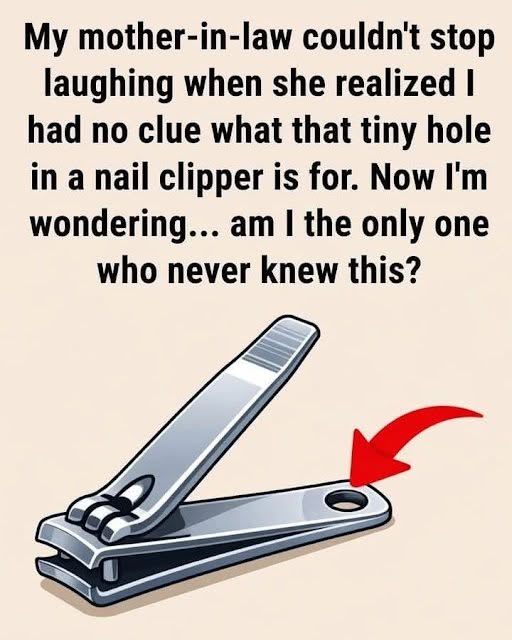
The cutting jaws provide the cutting surface.
The lever provides mechanical advantage.
The pivot or connecting components allow movement.
The handle provides a place for the user to apply pressure.
The small opening may assist with storage or attachment.
Why Nail Clippers Have Such a Strong Lever
The lever is one of the most clever parts of the design.
Your fingernails may not seem particularly tough, but cutting them cleanly requires concentrated force.
A nail clipper allows your finger to apply pressure over a relatively small area.
The lever multiplies that force.
This is why a person can cut through a nail using a small tool without having to squeeze extremely hard.
The mechanism is simple enough to manufacture cheaply but effective enough for everyday use.
The small round hole does not necessarily contribute to this cutting action.
Instead, its purpose is usually associated with convenience, attachment, or construction depending on the model.
The Hidden Features People Often Miss
Nail clippers can contain other features that are easy to overlook.
Some have a small nail file.
Others have a pointed cleaning tool.
Some designs incorporate a miniature attachment that can help clean beneath the edge of the nail.
These additional features are often folded into the body of the clipper.
The idea is straightforward: instead of carrying several grooming tools, one compact device can perform multiple functions.
This explains why people sometimes assume that every unusual opening on a nail clipper must have a secret purpose.
Manufacturers have been designing compact grooming tools for generations, and clever space-saving features are common.
Why Viral Posts Make the Hole Seem Mysterious
Social media has a particular fascination with everyday objects.
A post might show an ordinary household item and ask:
“Did you know what this is actually for?”
The format works because people encounter these objects constantly.
They assume they understand them.
Then someone points out a detail they’ve never noticed.
Suddenly, an ordinary nail clipper becomes a mystery.
The headline becomes even more effective when it promises a “secret” or “powerful” use.
That kind of wording encourages people to click, comment, and share.
But the reality is often less dramatic.
Many supposed “hidden functions” are simply ordinary design features that were never explained to the user.
The lesson is not that the object has magical capabilities.
The lesson is that everyday products often contain details we never think about.
What You Shouldn’t Do With the Hole