The tool is small enough to fit in your palm, but its components work together in a carefully engineered system.
Why People Rarely Ask About It
The nail clipper is an object most people use without thinking.
Unlike a smartphone or car, it does not require instructions.
You pick it up.
Place the cutting edges around the nail.
Press the lever.
Done.
Because the basic operation is so familiar, users rarely examine the construction.
That is why a small opening can go unnoticed for years.
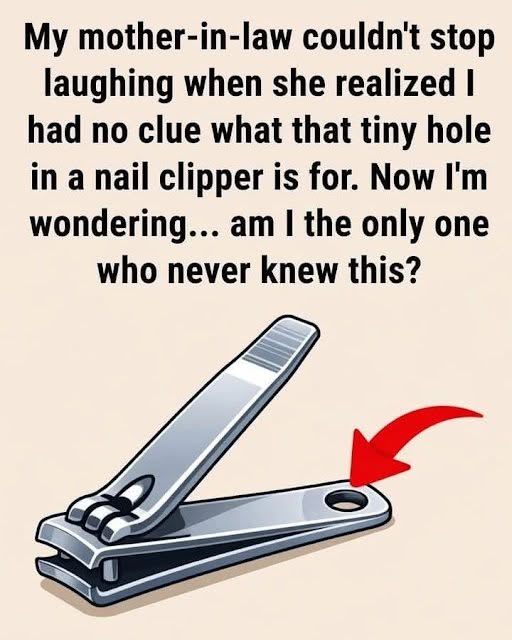
Someone may use nail clippers dozens or hundreds of times without ever wondering why a hole exists.
Then one day, they notice it.
And suddenly, the question seems obvious.
“What is that little hole actually for?”
The Real Answer Depends on the Design
The most important takeaway is that there is no universal explanation for every hole found on every nail clipper.
Some openings are attachment points.
Some are related to construction or assembly.
Some may have specialized purposes depending on the design.
The position and shape of the hole provide clues.
If it is located at the end of the clipper and appears large enough for a ring or hook, attachment is a likely purpose.
If it is part of a mechanical connection, it may have a role in the operation of the tool.
If the clipper contains additional grooming features, the opening may be integrated into that design.
So before believing an exaggerated social-media claim, look closely at the particular nail clipper you have.
A Reminder That Everyday Objects Can Be Interesting
There is something satisfying about discovering that an ordinary object has more thought behind it than we realized.
A nail clipper is not an exciting purchase.
It doesn’t have the glamour of a new phone or the complexity of a modern appliance.
Yet its design solves a very specific problem efficiently.
The small round hole is a reminder that even simple products can include features intended to improve storage, portability, assembly, or usability.
The next time you pick up a nail clipper, take a moment to examine it.
Look at the blades.
Look at the lever.
Look at the pivot.
Look at the small openings.
You may notice that the tool is more thoughtfully designed than it first appears.
The Internet Loves a “Secret”
There is a reason posts about hidden household features spread so quickly.
People enjoy learning that they have been using something incorrectly—or overlooking something—for years.