Another important point is that curiosity should not lead to unsafe experimentation.
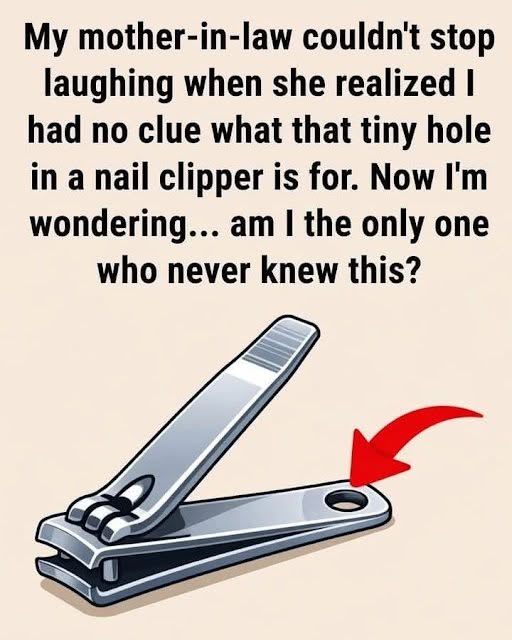
A nail clipper is designed primarily for grooming.
If an opening appears suitable for inserting a wire, sharp object, or other material, that does not necessarily mean it is intended for that purpose.
Using a tool outside its intended design can cause injury or damage.
Likewise, nail clippers should not be treated as universal cutting or piercing tools.
The blades are small but sharp.
The safest approach is to use the clipper as intended and follow the manufacturer’s instructions when additional functions are included.
Hygiene Matters More Than the Mystery
There is another nail-clipper detail that deserves more attention than the little hole itself: cleanliness.
Nail clippers come into direct contact with nails and sometimes the surrounding skin.
Over time, they can collect nail fragments, skin particles, dirt, and microorganisms.
That makes cleaning important.
After use, remove visible debris and clean the tool appropriately.
If the clipper is shared among family members, hygiene becomes even more important.
Ideally, personal grooming tools should not be shared casually.
Keeping the clipper dry after cleaning can also help prevent corrosion, particularly if it is made from metal that is not highly resistant to moisture.
A tiny tool still deserves basic hygiene care.
Why the Hole May Be Useful for Travelers
Travel is one situation in which small design features become especially valuable.
A nail clipper is easy to lose in a suitcase.
It can slip between clothing or disappear into a toiletry bag.
If the clipper has an opening that allows it to be attached to a ring or holder, it can be easier to keep track of.
Travelers also benefit from compact grooming kits because they reduce the number of individual objects that need to be packed.
The nail clipper’s small size already makes it useful for travel.
An attachment point can make it even more convenient.
Design Details Often Have Practical Reasons
One of the most interesting things about ordinary products is how often their designs reflect practical problems.
A hole may make something easier to hang.
A notch may provide space for another component.
A curved edge may improve comfort.
A textured surface may improve grip.
A foldable part may make the tool easier to carry.
Consumers often see the finished product without thinking about the decisions that went into designing it.
Nail clippers are a good example.