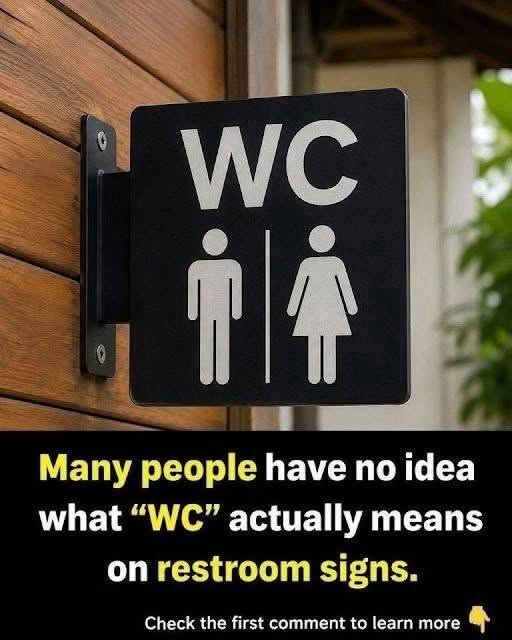
Then you notice:
WC
You may not know exactly what the letters stand for, but you may already recognize what they mean.
This is the practical power of international signage.
The same principle explains why symbols for airports, parking, information, exits, elevators, and accessibility are often designed to be understood visually or with minimal text.
WC fits naturally into this system.
It is not necessarily the most modern expression.
But it is efficient.
The Difference Between a WC and a Full Bathroom
There is also a more technical distinction worth noting.Match With Roommates
In some contexts, especially in architectural or plumbing terminology, a water closet can refer specifically to a room containing a toilet, separate from a larger bathroom.
For example, a home might have a bathroom containing a sink and bathtub, plus a separate small room containing only the toilet.
That small room may be described as a water closet.
This arrangement remains popular in certain types of modern residential design because it allows one person to use the toilet while another uses the shower or sink.
So although “water closet” sounds historical, the concept itself has not disappeared.
It simply became more specialized.
Why the Abbreviation Feels So Universal
There is something strangely satisfying about seeing WC on a sign.
The letters are visually simple.
They are easy to print.
They are easy to recognize.
And they avoid the cultural differences associated with words such as bathroom, toilet, or restroom.
A visitor does not need to know the entire history of the phrase.
They simply need to recognize the sign.Upgrade Bathroom Faucets
That is probably one of the biggest reasons WC continues to appear in international environments.
Language constantly changes, but useful signs have a tendency to survive.
A Tiny Piece of Everyday History
Most people never stop to think about restroom signs.
We see them, follow them, and move on.
But WC is a perfect example of how ordinary objects can contain unexpected pieces of history.
Those two letters connect modern travelers to the development of indoor plumbing, urban sanitation, engineering, architecture, and linguistic change.
The phrase began as a practical description of a new kind of toilet facility.
As plumbing technology developed, the water closet became increasingly ordinary.
The full phrase eventually sounded old-fashioned.But its abbreviation remained.
Today, you can walk through a modern international airport, see the letters WC, and unknowingly encounter a term whose origins reach back to the transformation of domestic sanitation.