In Britain and many other parts of the world, “toilet” is now an ordinary and completely neutral word.
In the United States, however, “toilet” often refers specifically to the physical fixture rather than the room.
Someone might say:
“I need to use the restroom.”
rather than:
“I need to use the toilet.”
This difference is a small example of how language reflects cultural attitudes.
The object is the same.
The function is the same.
But the preferred word changes depending on where you are.
WC as a Linguistic Time CapsulePerhaps the most interesting thing about WC is that it has outlived the popularity of the phrase that created it.
This happens frequently in language.Hire Local Plumbers
Words and abbreviations can survive long after the circumstances that originally produced them have changed.
Consider expressions involving technology.
People still “dial” a phone number even when many phones no longer have physical dials.
They may “hang up” even though there is no receiver to hang on anything.
They may “rewind” a video even when the content is stored digitally and cannot literally be rewound.
Language preserves history.
WC works in a similar way.
Modern toilets are not necessarily located in tiny closet-like rooms.
They may be part of enormous bathrooms containing multiple sinks, showers, changing areas, mirrors, and other facilities.
The phrase “water closet” therefore describes a historical concept more than a typical modern room.
Yet the two-letter abbreviation remains useful.
Is WC Used Everywhere?
No.
The popularity of WC varies considerably by country and region.
It is particularly familiar in Europe and in places influenced by European conventions.Style Home Decor
Travelers may encounter it frequently in airports, railway stations, restaurants, hotels, public buildings, and tourist areas.
In other countries, different signs may be preferred.
You might see:
Toilet
Restroom
Bathroom
Washroom
Lavatory
Ladies
Gents
Men
Women
A pictogram showing a person
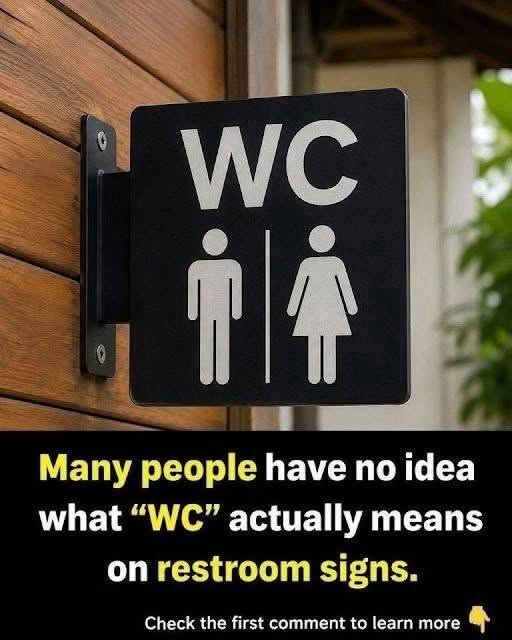
The pictograms are especially useful because they reduce dependence on written language.
Still, WC has an advantage: it is short.
A sign doesn’t need a sentence.Toilets
It doesn’t even need the full phrase “Water Closet.”
Two letters are enough.
The Role of WC in TravelFor international travelers, small symbols and abbreviations can be surprisingly important.
Imagine arriving at a railway station in a country where you do not speak the language.
You need a toilet.
You look around and see signs written entirely in unfamiliar words.