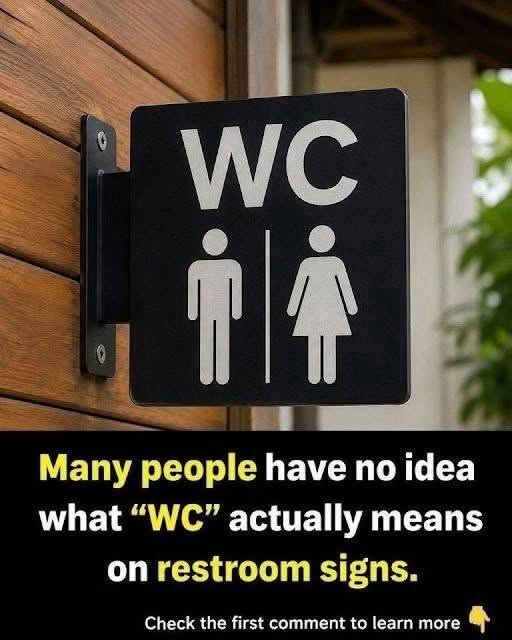
A sign reading “Restroom” is even more culturally specific.
But two simple letters can communicate the intended meaning across language barriers.
That makes WC particularly useful in places where travelers from many countries pass through.
Airports.
Train stations.Hotels.
Tourist attractions.
International transportation hubs.
The abbreviation does not require much translation.Match With Roommates
A traveler who has never spoken English may still recognize “WC” as a sign indicating a toilet.
This is one reason the abbreviation has survived long after the original English expression became uncommon.
WC Versus Bathroom
Another interesting question is why we don’t simply call every such room a bathroom.
The answer is partly linguistic and partly cultural.
In North American English, bathroom is one of the most common everyday terms for the room containing a toilet.
But the word technically refers to bathing.
A bathroom may contain a bathtub or shower, sink, toilet, or some combination of these fixtures.
In public places, Americans also commonly use restroom, a deliberately indirect term emphasizing privacy and comfort rather than the function of the toilet itself.
In British English, toilet is much more commonly used to refer directly to the room or facility.
Other languages have their own expressions.The terminology varies considerably from country to country.
Yet WC can function as a kind of linguistic shortcut.
It avoids choosing one particular language’s preferred word.Upgrade Bath Fixtures
Why “Restroom” Doesn’t Mean Resting
There is another fascinating example of how language can become detached from literal meaning.
In American English, “restroom” is widely understood to mean a public toilet facility.
But very few people actually go there to rest.
The word developed as a euphemistic expression.
Throughout history, people have often created polite alternatives for words associated with bodily functions. Different cultures use different forms of indirect language when discussing subjects considered private or impolite.
“Restroom” is one example.
“Bathroom” is another.
“Washroom” is yet another.
None of these terms necessarily describes exactly what the room contains.
“Water closet,” by contrast, was originally much more literal.
It described the technology.
A closet-like private space.
A toilet using water.
WC.
Why “Toilet” Became More Common
The word toilet itself has a long linguistic history.Schedule Trash Pickup
Its origins are connected to French and ultimately to ideas involving dressing and personal grooming. Over time, the word developed additional meanings connected with personal hygiene and eventually became strongly associated with the plumbing fixture and the room containing it.